
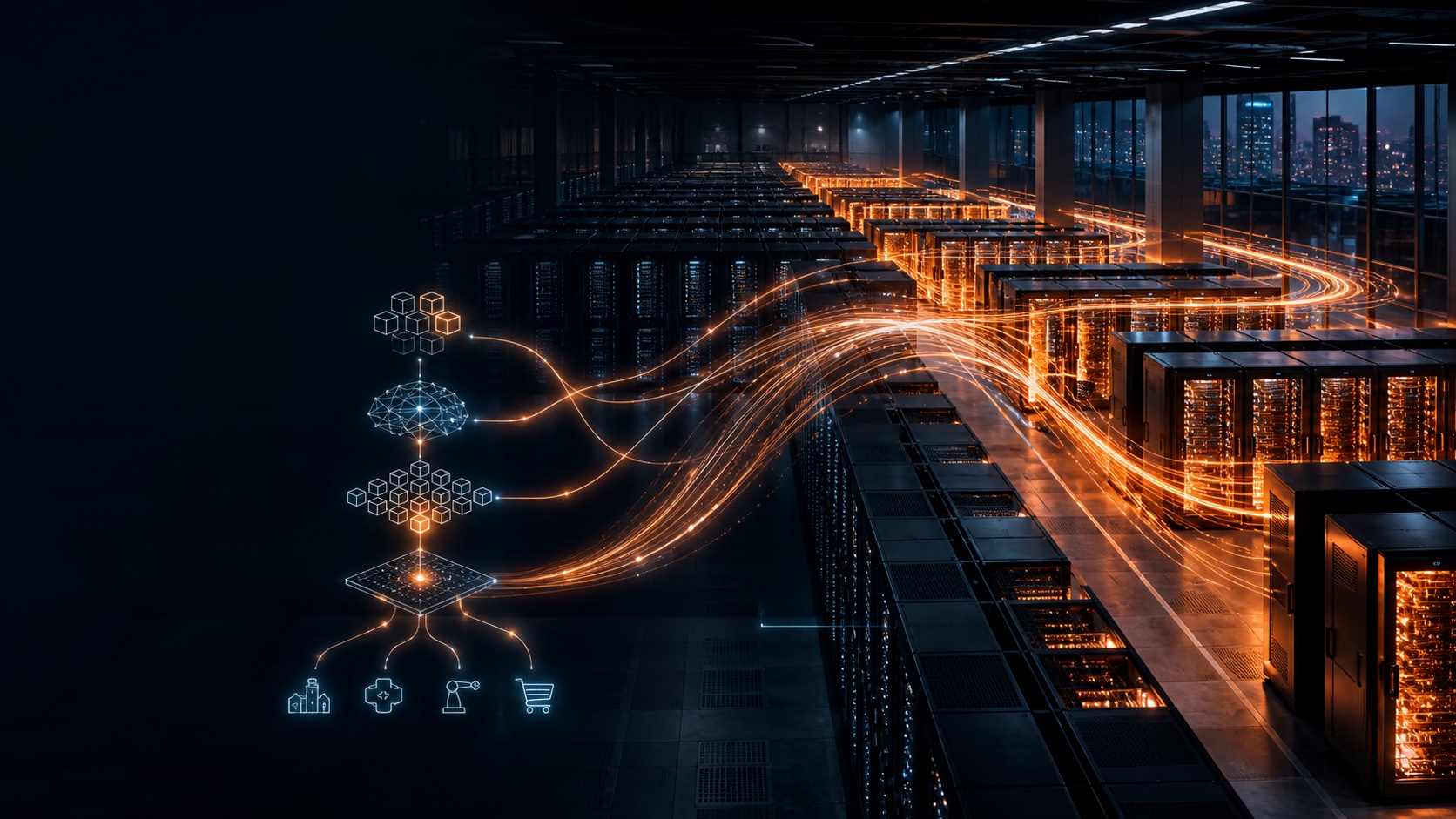
Demand for model training, industry inference and agents continues to rise, yet some deployed capacity still lacks stable workloads. Idle compute is rarely proof that the market needs no compute. It usually reveals a missing operating system between infrastructure supply and real business demand
01 · THE CAPACITY PARADOX
Why scarcity and idle capacity coexist
AI demand is not a smooth curve. Training creates periodic peaks, inference requires continuous response, development teams repeatedly create and release environments, while existing enterprise systems continue to run on virtual machines and containers
When an intelligent computing center stops at equipment procurement and facility delivery, theoretical capacity cannot automatically become usable business capability. Tasks wait for suitable resources while deployed hardware remains fragmented or inaccessible

02 · WHAT CUSTOMERS ACTUALLY FEEL
Customers rarely feel “idle compute”—they feel four delivery bottlenecks
The problem hides inside repeated resource requests, environment preparation, production release and cost reviews
Capacity exists, but teams cannot find it
GPUs are scattered across projects and pools. Busy and idle states remain unclear, so urgent teams wait while usable resources stay stranded
Hardware exists, but work cannot start
Chip, driver, framework, image and dependency versions constrain one another. Engineers spend time rebuilding environments instead of improving models and business outcomes
Models exist, but cannot reach production
Training, deployment and runtime use disconnected tools. Models remain in demonstrations because stable scaling, updates and business integration are difficult
Investment exists, but outcomes remain unclear
Utilization, wait time, release cycle and service cost are disconnected. Leaders can see procurement scale but cannot clearly see who the resources serve and what they produce
All four problems share one root cause: infrastructure supply and business delivery do not form a continuous path
03 · REAL BUSINESS SCENARIOS
Four scenarios determine whether compute enters production
Preserve existing systems
Carry virtualized databases, industrial software and business systems alongside new AI workloads without requiring a disruptive full migration
Accelerate development
Give teams repeatable environments, suitable GPU resources and a shorter path from resource request to experiment execution
Operate model services
Bring deployment, scaling, monitoring and rollback into one lifecycle so models remain reliable after training ends
Govern enterprise agents
Connect models, knowledge, tools and workflows within an observable and continuously evolving production boundary
04 · PiiEngine SOLUTION
PiiEngine: make compute flow around the business
PiiEngine, Zhuming Technology's intelligent-native platform, carries virtualization, cloud-native, intelligent computing and agent workloads on one foundation. It organizes CPU, GPU, storage and networking as a governed resource pool
Rather than forcing enterprises to replace every existing system, PiiEngine connects current workloads with new AI demand through unified resources, runtime and governance—creating a continuous path from models and applications to production

05 · BUSINESS VALUE
Turn infrastructure investment into measurable outcomes
Use resources effectively
Reduce fragmentation and dedicated-pool idleness through unified management and workload-aware allocation
Shorten AI delivery
Connect development, training, deployment and operations to lower coordination costs and reach production validation sooner
Protect existing investment
Retain virtualized and traditional workloads while progressively adding cloud-native, intelligent-compute and agent capabilities
Build operating capability
Use lifecycle governance and unified observability to continuously improve resource efficiency and service quality
06 · A NEW EVALUATION SYSTEM
Effective output matters more than theoretical peak
The next generation of intelligent computing centers should be measured by deliverable capacity, task wait time, model release cycle, service reliability, unit business cost and workload coordination—not hardware count alone
FROM INFRASTRUCTURE TO PRODUCTIVITY
Compute creates value only when it activates the business
The shift from building compute to operating it is a shift from infrastructure construction to AI production. PiiEngine closes the last gap between compute resources and business value: resources become callable, workloads become operable, models become deliverable and systems remain evolvable
About Zhuming Technology
Zhuming Technology builds runtime infrastructure connecting enterprise data centers, edge sites and intelligent devices, coordinating compute, models and missions across cloud, edge and device environments